Jet Ski Safaris in Tenerife: The Routes, the Wildlife, 1 Hour vs 2
A jet ski circuit is a taster. A safari is the actual meal. Instead of carving figure-eights inside a buoyed box off Puerto Colón, you follow a guide along the coast — past cliffs you can’t reach by road, into coves you’d never find alone, with full-throttle sections in open water between the sights. It’s the format that turns “we had a go on a jet ski” into the story people are still telling at dinner in November.
This guide covers the three safari lengths sold in south Tenerife — one hour, two hours, and the three-hour Los Gigantes epic — plus the stuff booking pages skim over: how the convoy works, what the guide’s signals mean, what the support boat does, and an honest account of the wildlife. For the full overview of jet skiing in Costa Adeje, start with the main guide and come back here for the deep dive.
What “safari” actually means (and why it’s not a circuit)
Operators in Tenerife sell two fundamentally different products under the “jet ski” banner:
- Circuit rides (20 or 40 minutes, roughly €60 and €75 per ski) keep you inside a marked practice area just offshore. You ride freely, but you go nowhere. Great for a first feel of the throttle; zero sightseeing.
- Safaris (1–3 hours) are guided point-to-point routes along the coast. You ride your own ski in a small convoy behind a lead guide, with the pace alternating between flat-out open-water legs and slow cruise sections past the sights. Longer safaris add a swim stop.
The practical rules are the same for both. No licence is needed on a guided safari — the guide’s commercial authorisation covers the group. You can drive from 16 with a parent’s signed consent (a national rule — under-18s carry the signed form plus a copy of the parent’s ID), operators require you to be 18 to carry a passenger, and most take pillions from around seven or eight years old and over 1.30 m tall (a few set the bar at ten). Combined weight limits run about 160–220 kg per ski. The full legal picture — including when you would need a licence — is in our Spanish jet ski licence guide.
Most departures run from Puerto Colón in Costa Adeje, each operator from its own gate or pontoon — though the two-hour format is often sold out of Las Galletas, at the coast’s eastern end. Check which harbour and which pantalán your ticket names, because Puerto Colón alone is bigger than it looks when you’re late.
The three safaris at a glance
| Safari | Time on water | Typical price per ski | Route | Swim stop |
|---|---|---|---|---|
| 1-hour coastal | 55–60 min | €90–120 | Costa Adeje coastline, La Caleta, golf-course cliffs | Rarely |
| 2-hour | ~2 h | €130–160 | The southern coast to Palm Mar, plus El Puertito cove | Yes |
| 3-hour Los Gigantes | ~3 h | €199–270 | The full south-west coast to the Los Gigantes cliffs | Yes |
Prices are per jet ski, not per person — a couple sharing a ski pays one price. Online booking discounts can knock a one-hour safari under €90 and a three-hour under €200; walk-up rates sit at the top of each range.
The one-hour safari: Costa Adeje’s coastline
The classic. You clear the harbour mouth at no-wake pace, the guide checks the group over, and the coast opens up to the north-west. First landmark: La Caleta, the old fishing village at the quiet end of Costa Adeje, where the restaurant terraces sit close enough to the water that you can smell the grills. Past it the shoreline turns wilder — dark volcanic rock, low cliffs with the golf course perched on top, and small stony coves that see a fraction of the beaches’ traffic.
The turnaround varies by operator and sea state — Playa Paraíso and Callao Salvaje are typical — and the run home is usually the fastest section, the guide letting the convoy stretch its legs in open water.
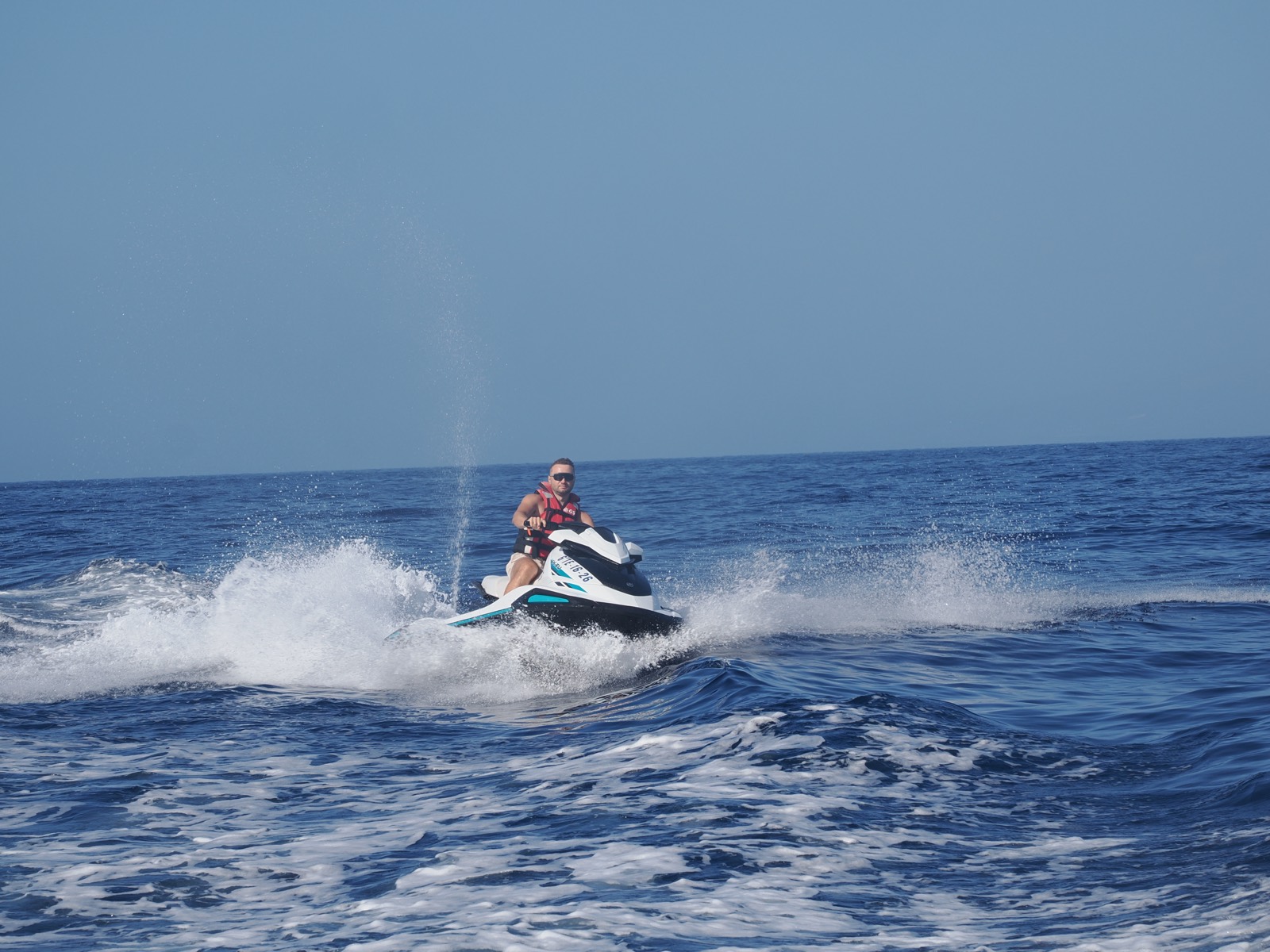 The one-hour route mixes sightseeing cruise sections with proper carving room in open water.
An hour sounds short. On a jet ski it isn’t — your forearms will confirm this. It’s the right length for first-timers who want a real route rather than a circuit. Deciding between this and the two-hour? The honest difference isn’t the scenery — it’s the swim stop.
The two-hour safari: Palm Mar and the El Puertito swim stop
The two-hour route is the best-balanced of the three, and the one that covers the southern stretch the other safaris skip. The departure point varies by operator — some run it out of Puerto Colón, others from Las Galletas at the coast’s eastern end — but the waypoints are the same: the beach fronts of Playa de las Américas and Los Cristianos (passed at a respectful distance and speed; bathing zones are strictly off-limits), then the Guaza cliffs, a wall of ochre volcanic rock most visitors never see because no road runs along it, and Palm Mar, the low-rise village behind the headland near Punta Rasca.
The route’s other anchor is El Puertito — a small, sheltered cove near Armeñime further up the coast, properly reachable only by sea or on foot. This is the swim stop: skis rafted or anchored, life jackets on, ten to fifteen minutes in clear water with the cliffs around you. It’s also where couples sharing a ski swap drivers (the person driving must be 18 if there’s a passenger aboard — an operator rule applied across the harbour).
Two hours covers a lot of coast — one operator quotes around 60 km of riding — and at €130–160 per ski it works out barely more per minute than the one-hour. For confident beginners and virtually all returning riders, this is the sweet spot.
The three-hour epic: Los Gigantes
The big one. Three hours, the full south-west coast, and a finish line that is one of the most dramatic pieces of coastline in the Canaries: the Acantilados de Los Gigantes, sheer basalt cliffs rising up to 600 m straight out of the Atlantic. Sitting on a jet ski at their base recalibrates your sense of scale — the fishing boats along the cliff foot look like bath toys.
The route runs north-west past everything the shorter safaris see — La Caleta, El Puertito, Playa Paraíso — then keeps going past Playa San Juan and Alcalá into the long open stretch below the cliffs. There’s a swim stop beneath the rock face when conditions allow, then the long run home, which your forearms will describe as “character-building”.
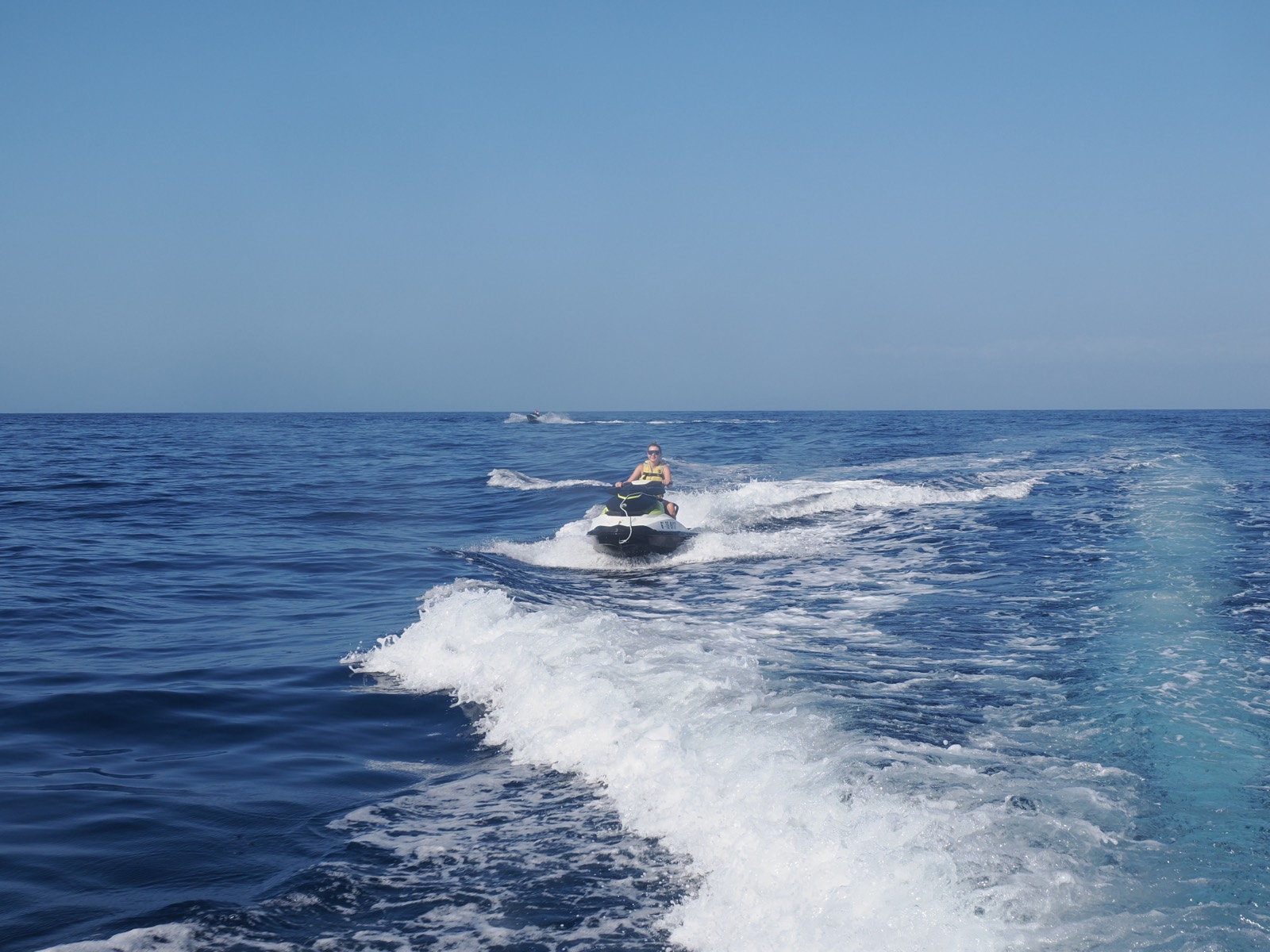 The Los Gigantes run has the longest open-water legs of any safari — this is where the skis get properly opened up.
Budget €199–270 per ski depending on operator and season, and treat this as a rider’s trip rather than a taster: you want a shorter ride behind you, decent core fitness, and a morning slot (more on why below). Details on the Los Gigantes area — and every other spot worth riding on the island — are in where to jet ski in Tenerife.
Convoy riding: how a safari group actually works
Every safari runs the same basic system, worth knowing before you’re bobbing at the harbour mouth trying to remember the briefing.
- The guide leads, always. Overtaking the guide is the one rule that gets shouted about — the guide is your navigation, your legal cover and your early warning for swimmers, ferries and reefs.
- Groups are small. Around eight skis per departure is a typical maximum, often fewer.
- Spacing is your job. Hold enough gap to the ski ahead to stop or swerve, and cross their wake at an angle rather than riding in their spray. Small hops over a wake are fine — great fun, honestly; stunt jumping is not, and guides will pull riders who try.
- Hand signals do the talking. You can’t hear anything at 70 km/h. A raised arm means slow and stop; a circling arm means gather round the guide; a flat palm patting downward means ease off. You get the full set in the briefing — there are only a handful.
- The kill cord stays on your wrist. Fall off and the engine cuts instantly. Falling off is rare on safaris — the cruise pace is gentle and the fast legs run in open water with nothing to hit.
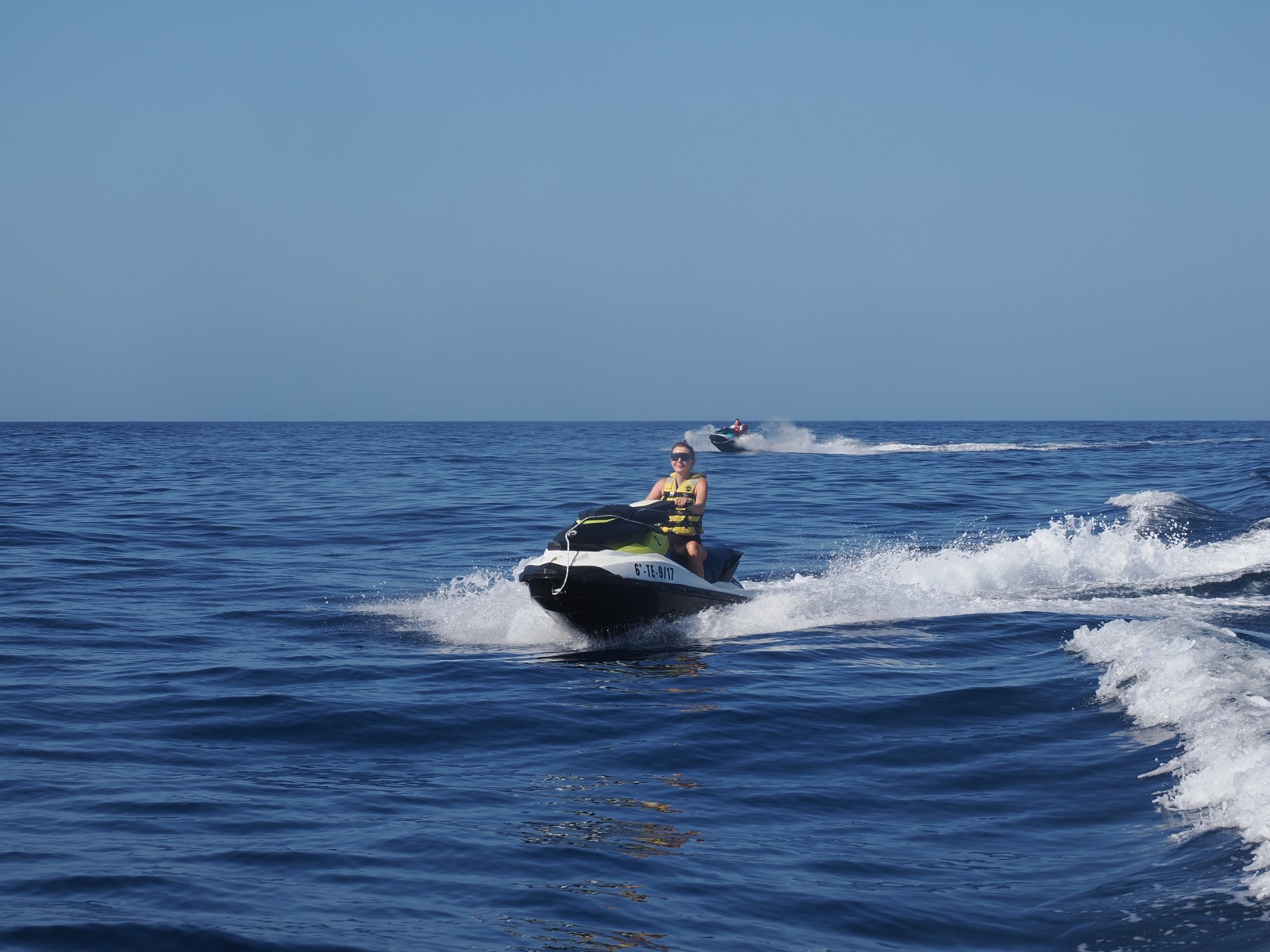 Convoy spacing in practice: close enough to read the guide’s signals, far enough to react.
The rhythm alternates deliberately. Out of the marina and past any beach zone you’re at walking pace — Spanish coastal rules keep powered craft slow and well clear of the bathing strips. In open water the guide winds it up and lets the convoy run hard; then a raised arm, everyone bunches, and you idle past the sight. Speed section, cruise section, repeat. It beats unrestricted riding for one simple reason: the fast bits happen where fast is actually safe.
The wildlife: what you might see, and the truth about what you won’t
Here’s where this guide will be blunter than the booking pages.
Pilot whales and dolphins — possible, never promised. The channel between Tenerife and La Gomera holds a resident population of short-finned pilot whales plus regular bottlenose dolphins — it’s why the whale-watching fleet exists. Safari routes cross the edge of this water, and sightings from a jet ski do happen: a fin line on the horizon, occasionally dolphins choosing to cross near the group. Treat it as a lucky bonus, not a feature you paid for.
When it happens, the law is specific. Spain’s cetacean protection decree (Real Decreto 1727/2007) draws a mobile protection zone of 500 m around any whale or dolphin group, with a hard 60 m exclusion zone no vessel may enter, low speed in the approach zone, and no approaching head-on, from directly behind or across the animals’ course. Jet skis are not authorised whale-watching craft, so a good guide throttles the convoy down or alters course — that’s the law working, not the fun dying. If cetaceans are the actual goal, book a licensed whale-watching boat as well; options are in our Costa Adeje water sports guide. The wider rules of engagement are summarised in the IWC Whale Watching Handbook.
Turtles — the honest version. For years El Puertito was famous for its green turtles, and the internet is still full of photos of them. The colony is gone. Illegal feeding, fishing gear and harassment — including from jet skis, uncomfortably — damaged it beyond recovery, and by around 2020 reliable sightings had ended. Any listing still promising you’ll “swim with turtles” at El Puertito is selling old photographs. You may glimpse a loggerhead in open water — they pass through — but nobody serious will guarantee it, and this site won’t either.
What you will reliably see: flying fish skipping out of your bow wave, shearwaters working the swell lines, and — below you at the swim stop — shoals of bream and the occasional ray over the sand. The cove snorkelling is genuinely good; it’s just not a turtle zoo any more.
Swim stops, driver swaps and the support boat
The swim stop is a bigger part of the two- and three-hour safaris than it sounds. Skis hold position in a sheltered cove — El Puertito on the two-hour, the cliff base on the Los Gigantes run — and you get ten to fifteen minutes in the water. Life jackets keep you floating without effort, the water is 18–24 °C year-round (a shortie wetsuit is usually offered in winter), and it’s the one point of the trip where you can look around instead of watching the ski in front. Swim stops are always conditions-permitting: if swell is running into the cove, the guide skips it or substitutes a calmer spot.
It’s also the driver-swap point for shared skis — one climb-aboard shuffle, and the passenger pilots the leg home.
On larger departures — and routinely on the three-hour — a support boat shadows the convoy. It carries the photographer, spare fuel and kit, gives a shaken or seasick passenger somewhere to ride that isn’t the back of a jet ski, and is the recovery plan if a ski develops a fault. Smaller groups run without one, the guide’s ski carrying the essentials.
Morning or afternoon?
Book the morning. The south-west coast wakes up calm, and the afternoon trade-wind chop arrives with impressive punctuality in summer. On a flat morning sea a safari feels fast, smooth and precise; the same route through afternoon chop is a workout with spray in your teeth. Confident riders sometimes prefer the lively afternoon sea — wake hops come free — but for first-timers, pillions and anyone doing the three-hour, the 9–11 a.m. departures are the ones to fight for. They sell out first in July and August for exactly this reason.
Photos: the packages and the phone ban
Your phone is not coming on the water. Every operator bans them and provides lockers at the base — a dropped phone in 40 m of Atlantic is unrecoverable, and insurance-wise it never happened. The rule annoys people at the briefing; everyone is grateful for it by the first fast section.
Instead, the guide — or the support-boat photographer on longer runs — shoots the group throughout, and the photo package is offered back at base for €10–30 depending on operator. Nobody is obliged to buy, and the action shots, taken while you were too busy grinning to pose, are usually the best souvenir of the trip. Some operators allow a GoPro on a proper chest or handlebar mount at your own risk; ask when booking, not at the pontoon.
Which safari for which rider?
| You are… | Book this | Why |
|---|---|---|
| A first-timer who wants a real ride | 1-hour safari | A proper route without committing your forearms to two hours |
| Nervous, or riding with a young pillion | 1-hour safari, morning slot | Calmest sea, shortest exposure, gentle pace at the back of the convoy |
| A couple sharing a ski | 2-hour safari | Per-ski pricing, swim stop, and a driver swap so you both pilot |
| A returning rider or confident beginner | 2-hour safari | Best coast-per-euro on the menu; both directions of coastline |
| Fit, experienced, and want the story | 3-hour Los Gigantes | The cliffs are worth every minute of the run; morning departure essential |
| Someone who hates group riding | None of them — yet | Solo hire without a guide exists but needs a licence; see the hire guide |
Booking mechanics are simple everywhere: reserve online (deposit now, balance at the base), arrive 30 minutes before departure for paperwork and briefing, bring swimwear, sunscreen and a towel, and check the free-cancellation window — 24 hours is typical, which matters on an island where the wind forecast can move your plans.
Frequently asked questions
Do I need a licence for a jet ski safari in Tenerife?
No. Guided safaris and circuits run under the operator’s commercial authorisation, so no licence or prior experience is required. You must be 16 to drive (with a parent’s signed consent if under 18), and operators require drivers to be 18 or over when carrying a passenger. Only unguided solo hire requires a qualification — normally the Spanish Licencia de Navegación, since foreign certificates are accepted only at an operator’s discretion; the full picture is in our licence guide. Bring photo ID for the paperwork.
How much does a jet ski safari cost in Tenerife?
Prices are per jet ski, not per person, which makes sharing good value. Expect €90–120 for the one-hour safari, €130–160 for the two-hour, and roughly €199–270 for the three-hour Los Gigantes run, with online booking discounts at the bottom of each range and walk-up rates at the top. Short circuit rides — 20 or 40 minutes in a marked area — cost about €60 and €75 respectively.
Will we see dolphins or whales on the safari?
Possibly — the Tenerife–La Gomera channel has resident pilot whales and bottlenose dolphins, and safari routes skirt that water. But no honest operator guarantees sightings, and Spanish law (Real Decreto 1727/2007) forbids any vessel approaching within 60 m of cetaceans, with a 500 m controlled zone around them. If a guide slows or detours away from animals, that’s the law working. For a dedicated sighting trip, book a licensed whale-watching boat instead.
Are there still turtles at El Puertito?
No — and it’s worth saying plainly. The famous green turtle colony was damaged beyond recovery by illegal feeding, fishing gear and harassment, and reliable sightings ended around 2020. The cove is still a lovely, sheltered swim stop with good snorkelling over rock and sand, but any listing promising turtle encounters there is trading on old photos. Loggerheads do pass through open water along this coast; seeing one is pure luck.
Can two people share one jet ski on a safari?
Yes — pricing is per ski, and doubles are the most popular booking. Operators require the driver to be 18 or over when carrying a passenger; pillions are accepted from around seven or eight years old and 1.30 m tall with most operators. Combined weight limits are about 160–220 kg per ski. On two- and three-hour safaris the swim stop doubles as a driver swap, so both riders get time at the throttle.
What happens if the weather is bad?
Operators monitor the wind forecast and will move or cancel departures when the sea is beyond the group’s ability — chop that’s fun for experts is misery for first-timers. In practice cancellations mean a free reschedule or refund, and most bookings carry free cancellation up to 24 hours out on your side too. Reduce the risk by booking a morning slot: the south-west coast is at its calmest before the afternoon trade winds arrive.
Can I take my phone or a GoPro on the ride?
Phones are banned on the water by every operator — lockers are provided at the base, and the rule exists because dropped phones are unrecoverable. Photo packages shot by the guide or support boat cost €10–30 and are optional. Some operators permit a GoPro on a secure chest or handlebar mount at your own risk; confirm when booking, because policies differ and a loose camera lasts about one fast section.